
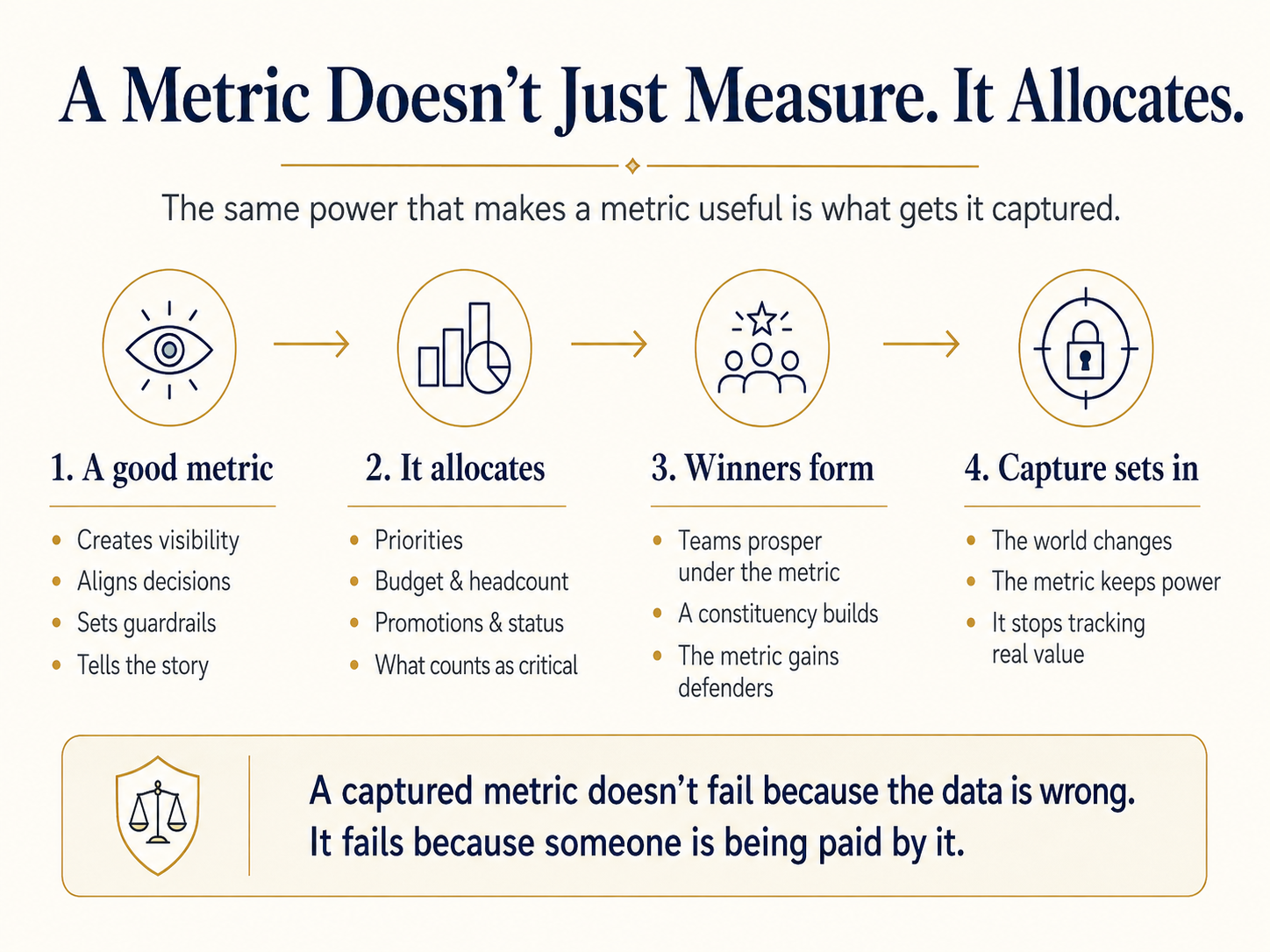
A good metric is one of the most powerful tools an organisation has. That is exactly the problem. It gives you visibility into a system too large to hold in your head, aligns thousands of decisions no one could coordinate by hand, sets the guardrails that keep a team honest, and tells the story of what the product and the business are becoming.
Unpriced value: enabling what customers could not do before, is where 0-to-1 innovation lives. So why do organisations refuse to fund it, and leaders struggle to care? Because a metric does not only measure. It allocates: decides priorities, who gets budget, who gets promoted, whose work counts as critical. And the same power that makes a metric worth having is what gets it captured.
Call it metric capture: a metric so useful that a constituency forms around it and defends it long after it has stopped tracking value. The name borrows from regulatory capture, and the mechanism is identical: the instrument meant to oversee ends up serving the overseen.
Capture is the tax on a metric that works.
This is not a story about vanity metrics or people gaming numbers. A metric powerful enough to allocate resources creates winners: the teams, leaders, and roadmaps that score well under it accrue budget, headcount, and visibility, and with them the standing to defend the metric that made them. So a metric has inertia because of the organisation built around it. The inertia is political. Seeing the better number is only part of the task; the rest is facing everyone who wins under the old one.
Which leads to the trap most teams never name: success is what captures hardest. The number you are proudest of has the largest constituency, which makes it the one you can least afford to question. Goodhart's Law is real: when a measure becomes a target, it stops being a good measure. But the reason the bad target survives is not statistical. It is that someone is being paid by it.
When frontier labs needed usage to soar, industry obliged: tokenmaxxing. OpenAI shipped plaques for crossing ten billion, a hundred billion, a trillion tokens; companies built internal leaderboards ranking employees by how many they burned. Token count became a proxy for productivity, a promotion case, a status game. Until the bills arrived. Meta's leaderboard came down two days after it leaked; Uber capped spend per engineer; even Altman calls the cost a "huge issue." The labs that pushed the number got caught by it too: Anthropic, after the same surge, added weekly caps that a proposed class action now targets, and moved to bill agent usage it had been subsidising many times over. A metric captured in record time; and abandoned, by buyers and sellers alike, almost as fast.
We have been here before.
I watched the rise of social media early in my career. In 2011, Indian media ran on traditional metrics: ratings, circulation, ad rates. By those numbers a celebrity's digital presence was worth nothing – these rights came free. Dashboards couldn't see the value, so the talent's managers couldn't value it. I thought the numbers were wrong. I conceived and incubated Fluence, the only wholly owned digital subsidiary of CA Media, raised $2M in board funding, and acquired the digital rights to a roster of India's biggest names - signing more than fifteen personalities, Amitabh Bachchan and Salman Khan among them.
Even with this value in hand, the first year was a fight to get attention and budget. There was no formal language for engagement, influence, or ROI yet, so the old metrics kept arguing it didn't matter. And the people, brands and companies those metrics had made successful believed them. The traditional numbers weren't lying; they were doing their job in the world they were built for – but this world was changing. Fluence was profitable within a year, and returned over 15x. The value that social media and a maturing internet had created existed. What was needed was the instrument to price it, and the work to break the capture of incumbent metrics.
We are about to be here again. The metrics of the social era: DAU, MAU, CTR and watch time were new in 2011. They measured exposure to these new digital spaces, communities and content. But GenAI, multimodal, and spatial interfaces aren’t about exposure. They’re about experience and outcome. A customer trying a product on, or shopping inside a virtual world, isn't an impression you count; it's an outcome you have to define. If you only measure exposure, you will optimise your product into irrelevance.
How to break the hold.
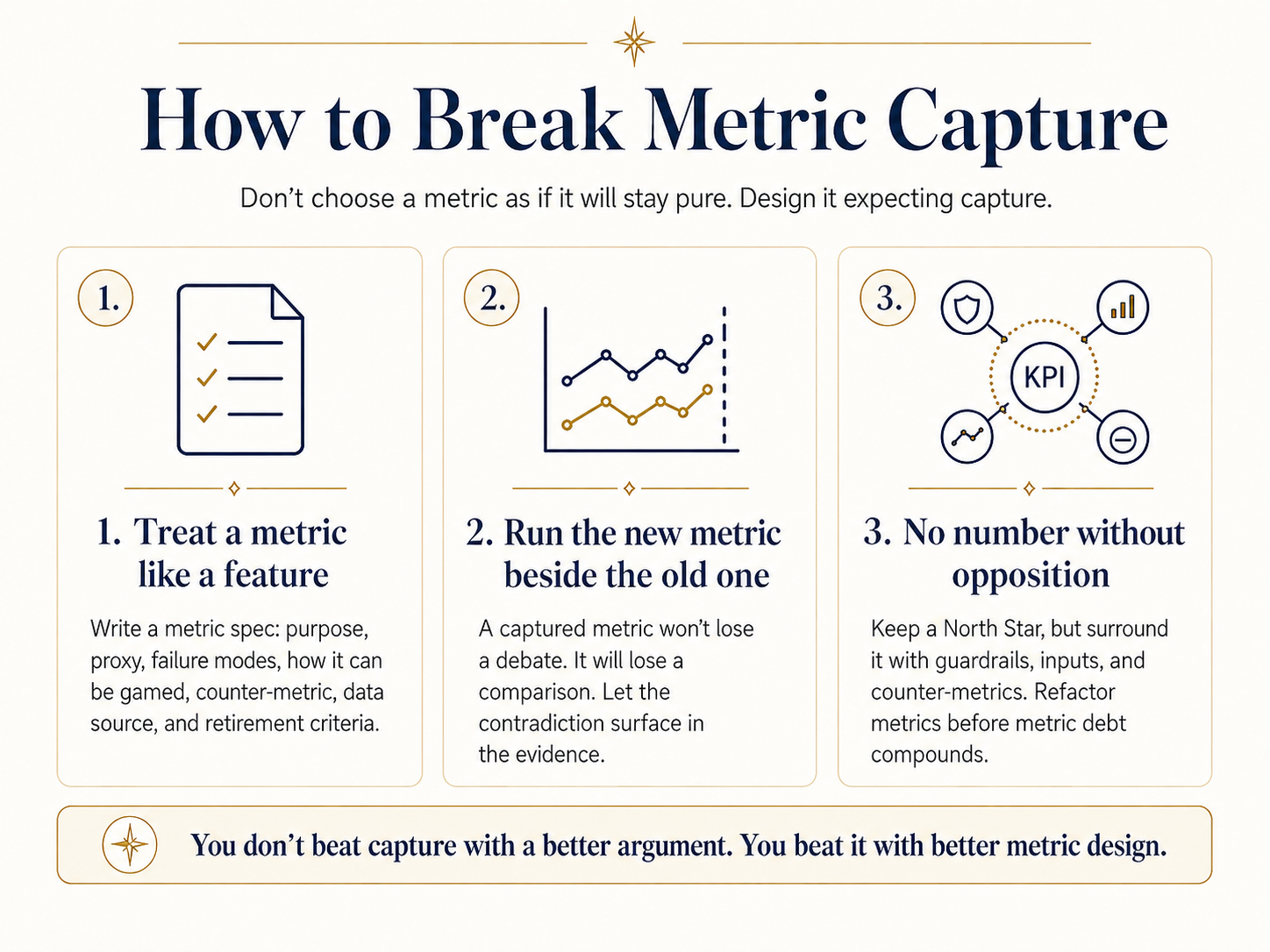
You do not beat capture by choosing a better metric. The better metric gets captured too. You beat it by designing metrics that expect to be captured.
Treat a metric like a feature. Write a metric spec. A metric is easy to question before anyone is winning from it. Once they are, the window closes. One page: what it is for, what it actually proxies, where it fails, how it can be gamed, the counter-metric that catches that, the data it is built from, and the criteria that will retire it. The discipline is in the context and failure modes: if you cannot state how a metric breaks, you are not ready to target it. Write the spec when you define the product or build the organisation. Not after launch.
Anthropic's lesson from automating its own analytics was blunt: documented metrics let AI speed up the work; undocumented ones just let it produce the mess faster, and with more confidence. An unspecified metric no longer sits still. It scales.
A captured metric won't lose a debate; it will lose a comparison. You cannot argue an incumbent metric out of power. So you do not have the meeting. You run the new metric beside the old one for a cycle and let the contradiction surface on its own evidence. At Fluence we never argued that the digital rights were underpriced; we ran reach, engagement and brand uplift next to traditional ad rates until the gap was impossible to ignore. You are not overruling the constituency. You are letting evidence do what argument cannot.
No single number should hold power without an opposition. A North Star is powerful for focus, and a core narrative KPI for telling your story. But around them you need a constellation: inputs, guardrails, and counter-metrics run as loyal opposition. Revenue hits target while listing quality quietly falls; that contradiction should be visible inside the same review. Budget time to refactor metrics: metric debt compounds like technical debt, and an unexamined dashboard is last year's strategy still giving orders.
The story you choose to tell.
A captured metric fails at everything that made it valuable: it stops showing you the system, aligns the org behind the wrong goal, drops its own guardrails, and tells a story about a product or company that is already being disrupted.
Your metrics are the story you tell about what matters. Make sure it’s still true.
Next: The Speed Trap. The most captured metric of all is velocity: and a team can be moving at record speed in no particular direction.
Metric Capture
A metric does not just measure. It allocates. Which makes changing one an act of politics, not analytics.