
Translation - turning a raw capability into something a customer can use - is where technology becomes product. The immediate question: what value did it actually create, and how would you know? I spent a year focused specifically on this, building the global measurement strategy for visual content at Amazon.
I looked after Amazon's multimedia systems, powering shopping across billions of products from the everything-store catalogue to luxury houses with their own studio. AI’s arrival collapsed the old walls between imagery, video, 3D/AR, and virtual worlds - putting every multimedia investment on one surface, with transformed economics, opportunities and problems.
Each medium sat at a different point of maturity, cost, customer expectation, and scale. We faced one particularly hard question: what is the incremental value, and how do we measure it? We could track impact, but not incrementality. When customers touch every new feature at once, you can see total impact rise but not which capability caused it. Our models could not isolate what the new capabilities were actually adding. We had measured the old behaviour well and the new behaviour not at all, so we had to rebuild the models and invent metrics for behaviour with no precedent.
The meter is running.
Innovation does not speak for itself. And the novelty window - the early stretch of any 0-to-1 effort when no one is asking about return - closes faster than teams expect. The day ROI becomes the question, you want to have been measuring all along. Traditional software cost almost nothing to run once built; AI costs money on every run, and we see the bill climbing even as the price of each token falls. When compute is a real marginal cost, the metric you choose is no longer a reporting decision: it is a margin decision.
The AI cost-pressures are here. SemiAnalysis (June 2026) maxed out OpenAI and Anthropic’s top tiers: a $200 ChatGPT Pro 20x plan can cost OpenAI up to $14,000 a month; Claude's $200 Max 20x, up to $8,000. Anthropic breaks even only around 20% utilisation; OpenAI, below 11.4%. These economics cannot last - not while private, and certainly not post-IPO. The pressure is not only that the clock is running, but that the bill is too.
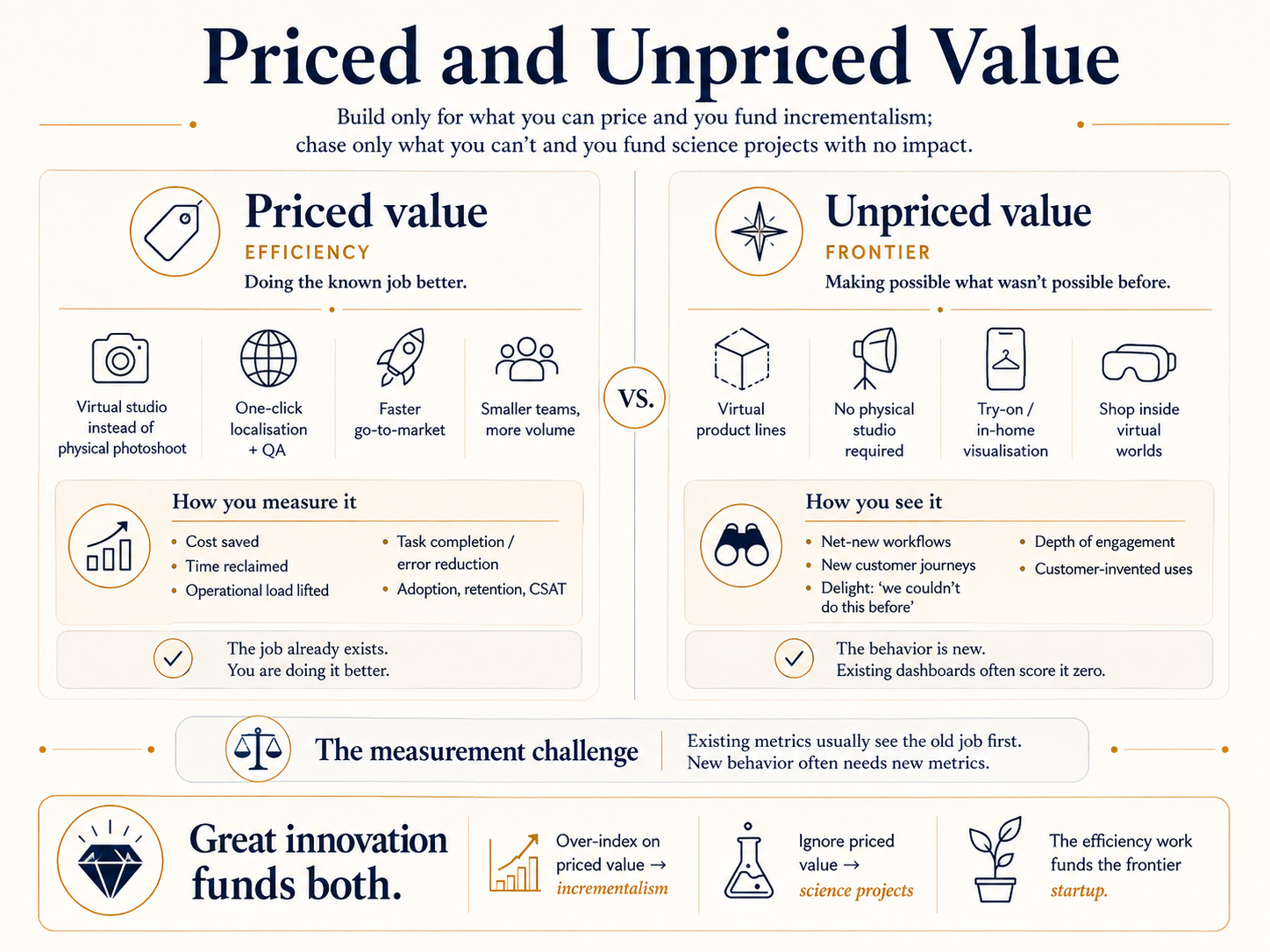
Priced value (efficiency): doing the known job better.
The first lens takes what exists and improves it: faster, cheaper and simpler, at higher volumes. This is not the same as the PM doing their job faster. It is the product doing the customer's job better.
A seasonal brand photoshoot used to cost $50K+, took weeks to plan and execute, and required physical products and a location. The same can now be done with digital workflows in a virtual studio in days, at a fraction of the cost. Localisation became one click and a QA pass. On our systems that meant compressed go-to-market cycles, iteration and volume at scale, fewer steps, and small teams doing what once required enterprise infrastructure. This is measured in the customer's currency. For business products: cost saved, time reclaimed, operational load lifted. For consumer tools and experiences: task completion, error reduction, fewer support contacts. Then watch adoption, retention, and CSAT to see whether the gain became a habit or was a one-time spike. Existing metrics and the north star already capture this.
Product-market fit is usually already established here. The job exists; you are doing it better. That is what makes this the safer lens, and the lower-ceiling one. It is often where leaders look first, because that is where the most immediate impact shows. The problem is when they look nowhere else.
Unpriced value (frontier): making possible what wasn't.
The second lens is where 0-to-1 innovation lives. It is the discovery of a different kind of value: enabling what customers could not do before. Priced value you measure in the customer's currency. Unpriced value has no currency yet: you must invent one, or stay blind to it.
With AI for visual media, we were not only automating workflows or translating global content. Brands with no physical studio could design and launch entire product lines virtually. Photoshoots and campaigns no longer needed the physical product, or a studio at all. Customers could see products on themselves, in their homes, and shop inside a virtual world. Whole content types appeared with no physical analogue, dynamically updating and scaling, with no prior market to compare them against.
This is the blind spot: a metric built for the old job scores the new one zero. The signals are different because the behaviour is new. You are not measuring a faster version of an old action; you are measuring one that did not exist. Look for net-new workflows and customer journeys, behaviour moving into spaces it had no reason to go before, and the qualitative tell that often begins in delight: we couldn't have done this before. Depth of engagement and the rate at which customers invent new uses tell you whether the capability is becoming foundational or staying experimental.
Here product-market fit is not settled, and that is the point. This is also the first place your existing dashboards go blind. They were built to measure the old behaviour, and they cannot see an action that did not exist when they were designed. Most teams under-invest in the frontier not because they choose to, but because nothing they measure, nor their incentive structures, can see it.
Balancing the two.
To anyone who has sat through a strategy offsite or an MBA classroom, two lenses for innovation will sound like frames they already know. They are not. McKinsey's Horizons sorts innovation by time; Christensen by market dynamics and portfolio theory, built for planners. Priced and unpriced sorts by measurability, the constraint the PM sees on Monday: not which horizon is this? but can my dashboard see it? Am I resourcing my products and teams correctly?
Great innovation is not choosing a lens. The priced grounds you in tangible value and direct business impact; the unpriced drives the roadmap three years out. Over-index on the priced and you drift into incrementalism; ignore it and you ship science projects with no impact. The way I framed it for my team: the efficiency work funds our frontier start-up. You can weight the two; you cannot zero out the unpriced. Set its share to nothing and you will keep optimising a known behaviour until the product ossifies and a structural shift makes the gains irrelevant.
The right weighting is not fixed. It is a function of where you sit: your stage, your market, the pace of capability in your category. There is no universal ratio, and anyone selling you one is selling a framework, not judgement. The best leaders fund both, because the value you can't price, you can't defend.
The pace is what raises the stakes on getting the weighting right. Amol Avasare, Anthropic's Head of Growth, said on Lenny's Podcast that most growth teams default to roughly 70% small optimisations; Anthropic inverts that ratio. The logic is structural: when capability compounds fast enough that a single shift - agentic coding - can render a year of interface refinements irrelevant, the era rewards a heavier tilt toward the frontier than any before it. And the opportunity cost is brutal: every engineer, every dollar, every week of focus spent perfecting the known is one not spent on the ever-moving frontier. The ratio is still yours to set.
Electricity lit homes more cheaply and reliably, and made it possible to keep food fresh at home without a daily ice delivery. The PC made office work more efficient, and gave rise to software no one had imagined needing. The spreadsheet alone sold a generation of machines. This is not new. The pace is.
What endures.
The value of innovation is not in the primitive or the feature. It is in what becomes possible for the customer because of it: sometimes a known job done cheaper and faster, sometimes an experience, a product, a world that could not exist before. The translation layer that turns a primitive into a product is where that value is born. Measure it there: not only in cost and speed, but in the behaviour that did not exist before. And the costs that don't yet have a name.
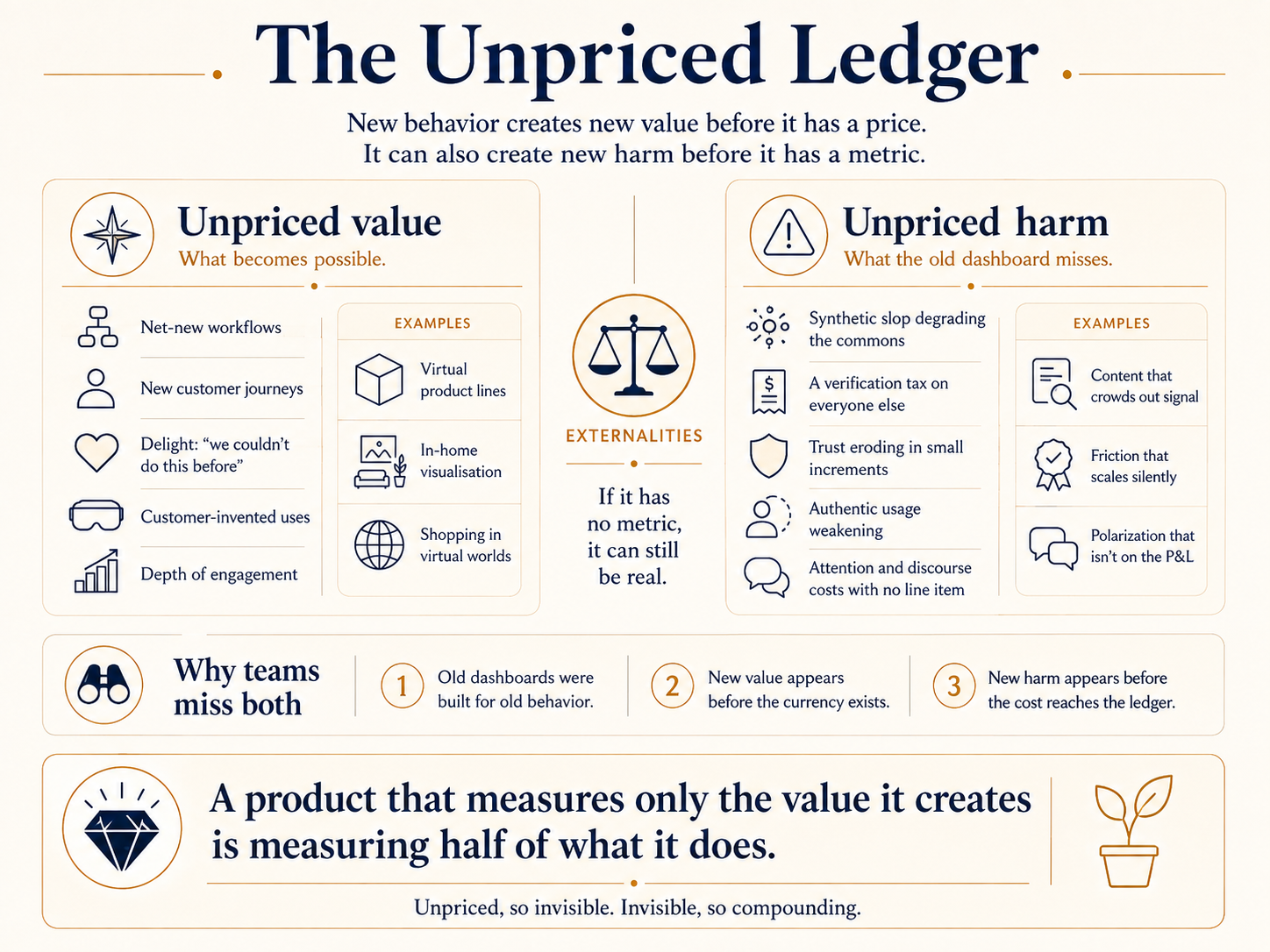
This unpriced ledger has two sides. The same fact that hides new value - no metric exists for new behaviour - hides new harm. Engagement metrics scored the social feed as a pure win for a decade because the costs had no line item: attention, trust, the texture of public discourse. Even Meta, at the pinnacle of the endless scroll, had not priced in long-term trust and authentic usage. Unpriced, so invisible; invisible, so compounding. Economics has a word for costs that never reach the ledger of the party creating them: externalities. AI produces them at the pace it produces unpriced value: slop degrading the commons, synthetic content taxing everyone's verification, trust eroding in increments no CSAT survey catches. A product that measures only the value it creates is measuring half of what it does to the customer, and the world.
Features are what went live, but value is what became possible.
Next: Metric Capture. Every metric that works creates winners, and winners defend the metric. Why changing one is as much politics as it is analytics.
Priced and Unpriced Value
Measuring value in innovation: Build only for what you can price and you fund incrementalism; chase only what you can't and you fund science projects with no impact.