
Forty-two. Deep Thought contemplates for seven and a half million years on the ultimate question of life, the universe, and everything, and returns: forty-two. Everyone remembers the punchline from The Hitchhiker’s Guide to the Galaxy, but not enough have read on. When Deep Thought’s makers protest, the machine points out that nobody ever knew what the question was, and hence the answer remains incomprehensible. It offers to design a computer that can: our very home planet, the Earth. A single program running ten million years, with every living being woven into the computation.
Douglas Adams was exact in the sizing of his machines. The answer took a skyscraper-sized supercomputer to produce. The question took a planet, ran longer, and needed everyone on it. He priced the two correctly. Answers are the cheap computation. Questions are the expensive one.
We have just cut the price of answers by several orders of magnitude, and we are discovering, day by day, why Adams was not exaggerating.
The inversion
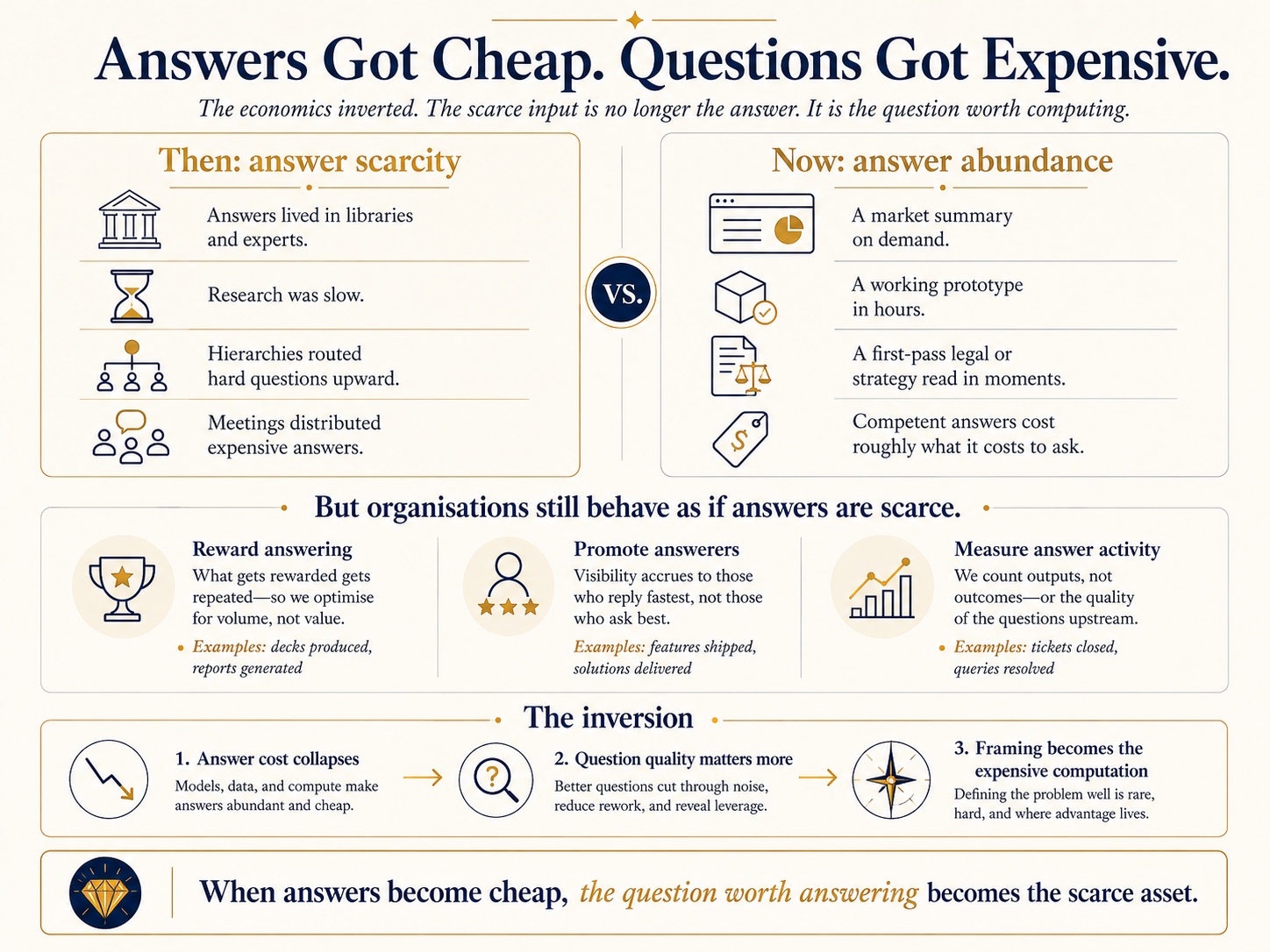
For most of working history, answers were scarce. If you wanted to know whether a market existed, what a system cost to run, or how a competitor's product worked, someone had to go and find out. Answers lived in libraries, experts, research departments, and consultants billed by the hour.
So, we built organisations around answer scarcity, and the co-ordination this demands. Hierarchies exist partly to route hard questions upward to the person who holds the answer. Firms, to manage co-ordination. Meetings exist partly to solve and then distribute answers that were expensive to obtain. The internet exploded our access to information, but someone still had to compile the answers.
Then the price collapsed. A monthly strategy document, a working prototype, a market summary, a first-pass legal read: each now costs roughly what it costs to ask for it. Not a perfect answer, but a competent one, in moments, on demand.
Prices move faster than habits, and organisations still behave as if answers were scarce. They reward answering, promote answerers, and measure answer activity: decks produced, features shipped, tickets closed. Meanwhile the input that actually became scarce is the question worth answering. Watch a product or business team for a week and count the hours spent polishing answers against the hours spent framing questions. The ratio has not moved since the tools arrived. The economics underneath it has inverted.
Four ways to ask the wrong question
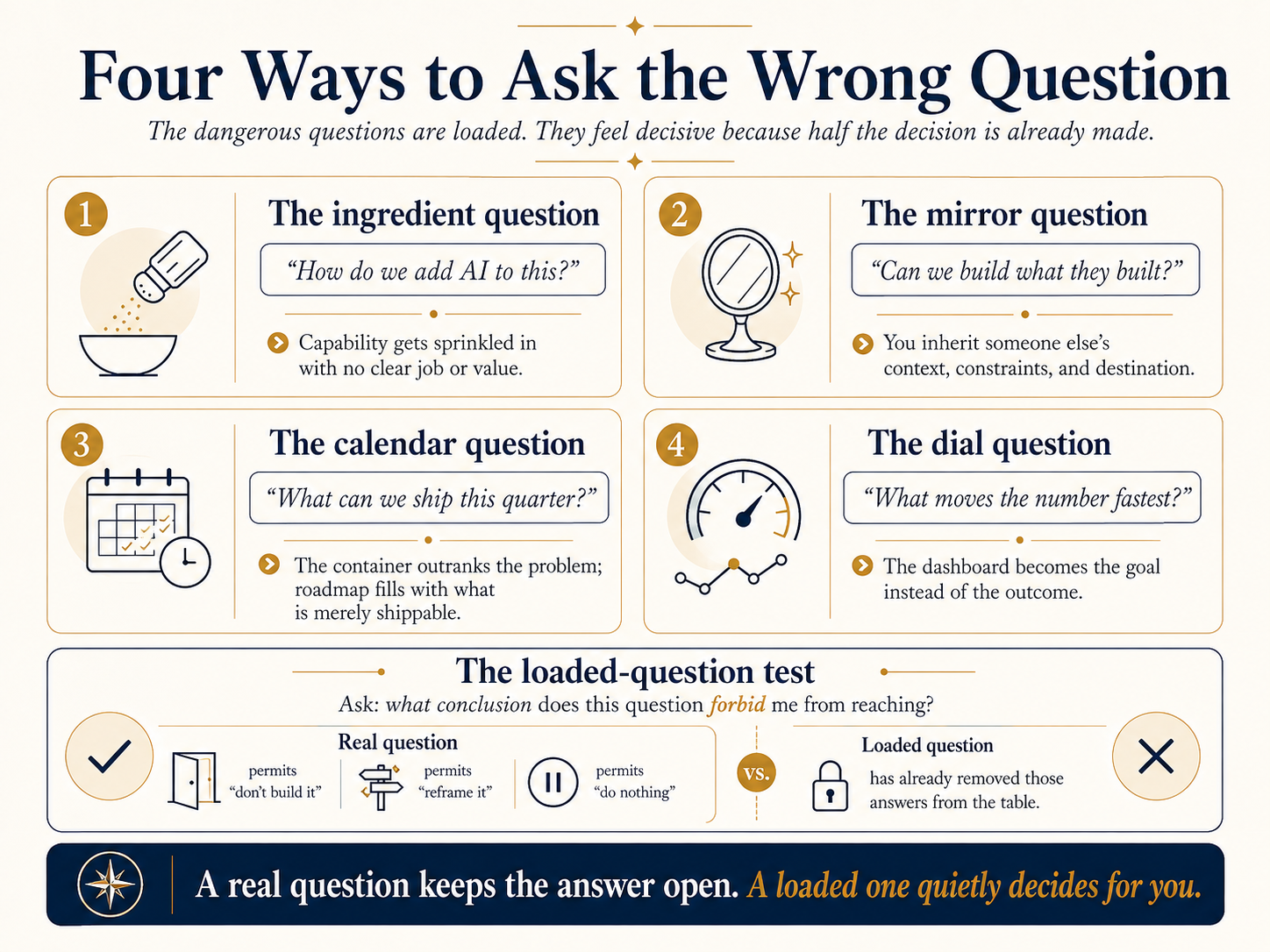
The wrong questions are not exotic; we have all heard them. Four archetypes of them do most of the damage, and they run on repeat in most organisations right now.
The ingredient question. How do we add AI to this? Technology cast as an ingredient to be stirred in. It produces primitives mistaken for products and feature salad: capabilities sprinkled across a product and its architecture with no job holding them together, and no clear value added for builders or users.
The mirror question. Can we build what they built? You inherit another company's constraints and bury your own. Their question was shaped by their data, their margins, their users. Yours arrives pre-answered by someone else's context.
The calendar question. What can we ship this quarter? The date becomes the boss. Work gets scoped to fit the container rather than the problem, and the roadmap fills with things that are shippable rather than things that matter.
The dial question. What moves the number fastest? The metric picks the goal, and the team ends up optimising the dashboard it inherited rather than the outcome it wants.
Each one is loaded with its own answer inside it. "How do we add AI" has already decided to add AI. "Can we copy them" has already decided the destination. "What ships this quarter" has already decided the deadline outranks the problem. "What moves the number" has already decided the metric is the point. These questions feel decisive precisely because half the decision is pre-made.
The test is cheap to run. Take the question your team is organised around and ask what it forbids you from concluding. A real question permits the answer 'don't build/do this'; a loaded one has quietly removed it from the table. That is why they feel so productive: every path from a loaded question leads somewhere specific, and none leads back out.
The laundering
I watched Amazon build six separate 3D and AR shopping experiences, owned by six separate teams. The question we were answering was how to use spatial and immersive technology, and match what competitors were launching, to transform home shopping. The result was six separate front doors to disparate experiences: cognitive load passed to the customer, disconnected experiences you had to leave and re-enter, different maturities, no aligned product-market fit, and nobody holding the holistic view of the person actually shopping.
A wrong question used to die of cost. Pursuing it meant a team, a quarter, and a budget line, and somewhere along the way a sceptical engineer or a finance partner would ask what problem this actually solved. That is what eventually happened to Amazon's larger set of 3D and AR experiences: pared down and dispersed across the site. Displaced, ironically, by AI.
Now, a wrong question gets laundered in an afternoon: a fluent deck, a working prototype, confident projections, all polished to the standard that used to signal weeks of careful work. The quality of the answer disguises the quality of the question.
The models make it worse, in a specific way. They are agreeable by design: trained to be helpful, tuned to say yes in a courteous voice. Hand one a vague or leading question and it will not push back; it will invent the connective tissue you didn't know you were implying and return your framing error to you as confident prose. It is a mirror with excellent manners. The craft now lies in sculpting the question.
The Question Quotient
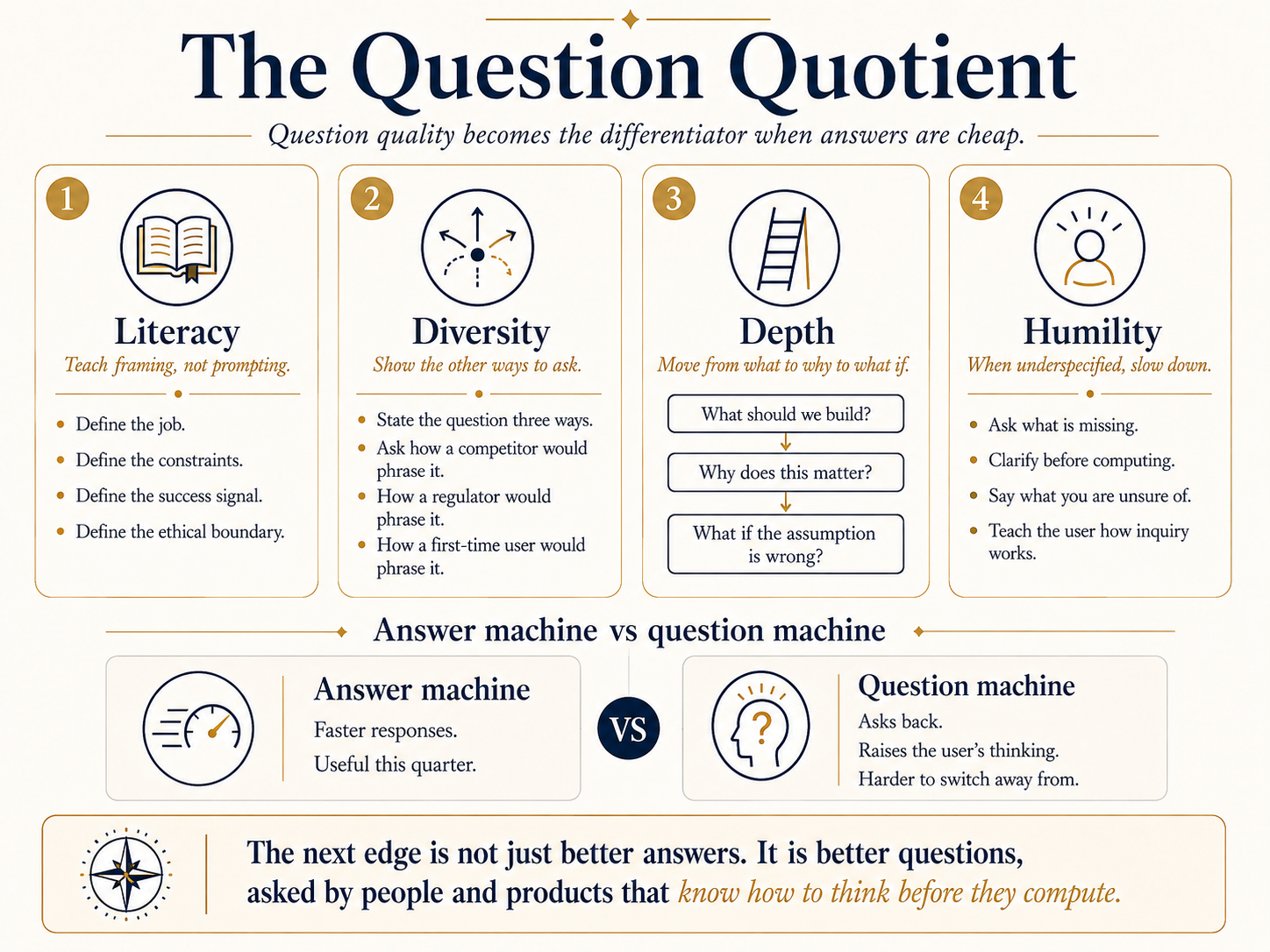
If the question is now the expensive computation, then the capacity to ask well is worth building. Call it the Question Quotient: how good a person, a team, or a product is at framing the problem before computing the answer.
If IQ measures intellect and EQ empathy, QQ measures the clarity and curiosity of inquiry: and it is becoming the differentiator for teams, users, and systems alike. It is not prompt engineering, which optimises the phrasing of a question the machine will answer; the Question Quotient sits upstream, deciding whether the question deserves a prompt at all. It is not the five whys, which drills into a problem already chosen; this is about choosing. It is bringing the Socratic method back to the centre: the old discipline matters most precisely when everything downstream of it runs itself.
The quotient has four components, and each disarms one of the loaded questions.
Literacy: teach framing, not prompting. It catches the ingredient question. We train people to use tools for output. Question literacy means articulating intent: the job, the constraints, the success signal, the ethical boundary, all before a single token is generated. AI excels at extrapolation; humans must supply direction.
Amazon's working backwards institutionalised this decades before the current tools existed. The press release and FAQ that precede any serious initiative are not writing exercises; they are a question technology. Who is the customer? What is their problem? How do you know? What does success look like? The mechanism forces the expensive computation to run first. Some of the best meetings I witnessed at Amazon ran multi-year architecture and supply-chain strategies off the back of one robust PR/FAQ, with Jeff Bezos and Wilke in the room. I have also had my own ideas whittled down this way: a 3D-guided 2D image system I championed only earned a build after it was rebuilt around the workflows creators actually had.
Diversity: show the other ways to ask. It catches the mirror question. When everyone asks the same way, systems converge to the same mediocre mean, and a thousand teams prompting from the same defaults build a thousand versions of the same product. The correction is deliberate reframing, using the right context and owned data: state the question three ways before accepting one, and treat "how would a competitor, a regulator, and a first-time user each phrase this?" as standard practice rather than a workshop game.
Designers and marketers ritualised this long before the models arrived: Crazy 8s, 'yes, and', change one constraint and ask again. The sketches were never the point; forcing eight framings before falling for one was. The prerequisite is range: you cannot reframe a problem you hold only one vocabulary for, which is why the best questioners read outside their lane and carry context and knowledge across silos.
Depth: move from what to why to what if. It catches the dial question. Shallow questions optimise for convenience; deep questions expand perspective. "What should we build?" is a request for output. "Why does this matter to anyone?" is a request for judgement. "What if the assumption underneath it is wrong?" is a request for insurance. "How do we improve engagement?" becomes "what emotion do we want to evoke?" Most teams live on the first rung because the first rung is the one the tools answer instantly. Design for layers of depth, not one-click curiosity.
Humility: when underspecified, slow down. It catches the calendar question. AI systems are built to answer, even when they shouldn't; part of intelligence is knowing when not to reply. A good doctor does not answer "what's the strongest painkiller you have?" She asks where it hurts, since when, and what else is going on, because the stated question is rarely the real one. The machines answer the stated question every time, at any level of vagueness.
Supplying the missing pieces remains our job: and so does judging the output, because the taste to tell a ready question from a rushed one, and a good answer from a merely fluent one, is not a technique. It is experience: earned by asking badly, shipping the wrong thing, and paying for it. Interfaces can model this humility too: "your question is under-specified; here is what I need to know" teaching users how real inquiry works: iterative, provisional, alive. Using simple probes like red teaming, what am I missing, what are you unsure of, helps the model take you through this inquiry.
Products that ask back
There is a product argument buried in this, and it points away from where most AI teams are running. Almost every AI product competes on answer quality: faster responses, longer context, better benchmarks. That race is real, and no one holds a lead in it for long. The next generation will compete on Question Quotient: how well a product raises the user's thinking in the act of solving.
Versions of this have already shipped. Claude's Learning Mode answers a student's question with the questions a tutor would ask: how would you approach it, what evidence supports your conclusion. OpenAI's Study Mode and Google's Guided Learning followed, which is the market moving, not one lab. Claude Science, the research workbench Anthropic shipped this summer, drafts its plan and asks for approval before it runs: the question before the computation. Each looks like friction; each is value. Amol Avasare, Anthropic's head of growth, calls it good friction: the onboarding quiz that routes a new user to the right capability and lifts retention. LLMs are still an answer machine by default; the asking lives in modes and moments, opt-in at the edges. An answer machine makes you faster this quarter. A question machine makes you better permanently, and better is harder to switch away from than faster.
The oldest technology
Socrates wrote nothing down. His entire method was the question: asked, sharpened, asked again. It has now outlived papyrus, parchment, print, broadcast, and search, every one of which made answers cheaper and none of which touched it. Toyota built the same insight into a factory discipline: whys asked in sequence, before anyone fixes anything, a practice Taiichi Ohno called the basis of Toyota's scientific approach. The pattern is old enough to trust. Every technology that cut the price of answers raised the value of the question, and the people who understood that first ran the era that followed.
The current wave will commoditise its own asking: study modes have multiplied across every assistant, and two more years of this makes the Question Quotient look like one more feature. But every new layer: prompt to loop to agent, is a fractal of the same shape. At the top sits the primary question, and it has not moved since Deep Thought, because it cannot: a system can interrogate any goal except the one that tells it which goals matter. The machinery of asking will keep getting cheaper. The reason for asking stays ours.
Douglas Adams understood it too. When the galaxy finally possessed a perfect answer, its response was to build a question machine: and the machine was a planet full of people going about their lives, because the question of life cannot be computed from outside the problem. It is the problem. The models will keep getting better at answers.
The other machine is us, the humans, and it only runs if we do.
Next: Beyond the Blank Box. Every new medium begins in the borrowed clothes of the last one. Prompts were the bridge to AI. Bridges are for crossing.
Question Quotient
Cheap answers, expensive questions, and why the price of asking well just went up exponentially.